AI for Professionals: What You Actually Need to Learn in 2026

AI for Professionals: What You Actually Need to Learn in 2026
There’s a version of the “AI skills” conversation that goes like this: Learn Python, build neural networks, understand large language model architecture.
That kind of knowledge has its place, especially for technical teams. But for many working professionals in Singapore, it is not the most useful place to start.
If you work in marketing, HR, finance, operations, project management, or another business function, the AI skills you need in 2026 may look very different from what many people assume.
You do not need to become a data scientist. You need to understand what AI can do, how to use it well, and how to apply it with judgement in your own work.
This article breaks down what that looks like in practice.
Why Some AI Skills Advice Misses the Mark for Working Professionals
Advice written for developers and advice written for working professionals often get lumped together. The result is that professionals searching for AI training end up in courses that teach them to write code when what they actually need is to understand what AI can do for their specific work, and how to direct it well.
The gap between “understanding AI” and “building AI” is enormous. For most Singapore working professionals, building AI systems is not the most immediate or useful priority. What matters first is understanding how to work with AI well.
Here’s what a mismatch can look like in practice: You enroll in a Python course because someone said it was useful for AI. You spend several weekends on syntax and loops, but still do not feel any clearer about how AI can help you in your work on Monday morning. It is easy to walk away thinking, “Maybe AI just isn’t for me.”
But that may not be true. The course may simply not have been designed around the kind of AI skills your role actually needs.
What “AI Literacy” Actually Means in a Professional Context
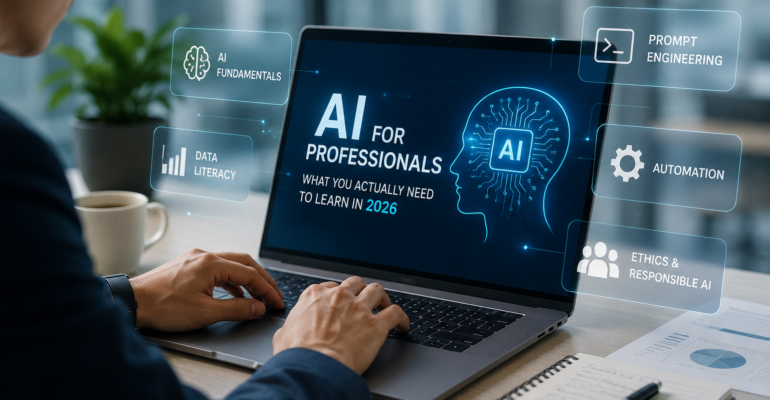
AI literacy for working professionals in 2026 is made up of four things and none of them require writing a single line of code.
1. Understanding what AI tools can and cannot do
This sounds basic, but it’s the foundation everything else builds on. Without this foundation, it is easy to either over-trust AI and miss its risks, or under-use it and miss its opportunities. Both can be costly.
Practically, this means being able to answer questions like: When does generative AI hallucinate, and how do I check? What types of tasks are genuinely good fits for AI automation? Where does human judgment remain essential?
These aren’t abstract questions. They come up in meetings, in procurement decisions, in performance reviews.
2. Using AI tools fluently in your existing workflow
The biggest AI productivity gains in 2026 are not coming from exotic new platforms. They’re coming from people who have learned to use the AI that’s already inside their tools Microsoft 365 Copilot, Google Workspace’s AI features, and the AI assistants embedded in the software their companies already pay for.
Many professionals in Singapore may already have access to these tools, but have not yet had the chance to learn how to use them in a structured, practical way.
What fluency looks like here: writing prompts that get useful outputs consistently; using Copilot to summarise documents, draft communications, and prepare for meetings; understanding how to review and verify AI-generated content before it goes anywhere official.
3. Applying AI to your specific function
This is where general AI training needs to be complemented by function-specific learning. The way AI changes the work of an HR professional is fundamentally different from the way it changes the work of a marketing manager. The tools may overlap, but the applications can look very different.
For HR: AI is changing how teams approach candidate screening, interview structuring, and onboarding communications. The useful skill is not simply knowing that AI can generate interview questions. It is understanding how to use AI to support better hiring decisions while still applying fairness, context, human judgement, and role-specific evaluation.
For marketing: AI is transforming content production, campaign analysis, and personalisation at scale. However, effective use is not just about generating more copy or images faster. It is about knowing how to guide AI outputs with brand judgement, audience insight, creative direction, and performance thinking.
For operations and management: Agentic AI and process automation are becoming increasingly relevant to workflow design, process improvement, reporting, and decision support. The priority is knowing where automation can create real operational value, where human oversight is still needed, and how to manage the risks that come with changing how work gets done.
4. Knowing how to stay current without constantly starting over
AI is moving quickly, and not every update will matter equally to your work. A useful skill for 2026 is knowing how to assess what is relevant, what is worth testing or using, and what can be set aside.
This is a meta-skill. It’s about developing a relationship with learning, not just completing a course. Professionals who manage this well tend to have a clear functional understanding of AI, so that new developments fit into something they already understand instead of feeling like a complete restart.
SkillsFuture-Eligible AI Courses in Singapore
These skills can be built through structured, accredited courses in Singapore, and much of this learning may be subsidised.
Innohat Training offers WSQ-accredited AI courses for working professionals, including:
- Microsoft 365 Copilot for Enhanced Workplace Productivity – Practical AI tool fluency for professionals already working in Microsoft environments
- AI Powered Agentic Process Automation (APA) – For professionals looking to understand and implement AI-driven workflow automation
- Digital Transformation & Business Innovation With AI – A broader course covering how generative AI is reshaping business functions
- Transforming Interview Strategies with Gen AI for Better Hiring – Function-specific AI application for HR professionals
- AI-Powered Digital Marketing Strategies – For marketing professionals adapting to AI-driven campaign management
All courses are eligible for SkillsFuture Credit. Singaporeans aged 40 and above may qualify for the Mid-Career Enhanced Subsidy, which can cover up to 90% of course fees.
The Bottom Line
For many working professionals, the AI skills that matter most in 2026 are not about building AI from scratch. They are about directing it, evaluating it, and integrating it into work that already exists. The professionals who develop these skills don’t just become more productive. They become the people their organisations rely on to navigate change thoughtfully.
You don’t need to start from scratch. You need to start from where you already are.
Contact us now to start your learning path.
Innohat Training offers WSQ-accredited AI and digital skills courses for working professionals in Singapore. All courses are eligible for SkillsFuture Credit. View our AI courses →